
Topics
Eight Categories
32 Questions
Kearney Commercial Roofing FAQ
Straight Answers on Membranes, Metal Panels, Permits, and Cost
This Kearney commercial roofing FAQ answers the questions building owners ask about TPO, EPDM, industrial, and metal roofs, cost, permits, and nearby towns.
Answers
Short Answer First
Need an Answer About Your Own Roof?
Every row in our Kearney commercial roofing FAQ shows a short answer first, with the full answer one tap away. For a question about your building, call us.
Kearney Commercial Roofing FAQ by Topic
Jump to a topic, or scroll through all eight.
Kearney Commercial Roofing Basics
What flat roofing systems work on Kearney commercial buildings?
TPO or EPDM
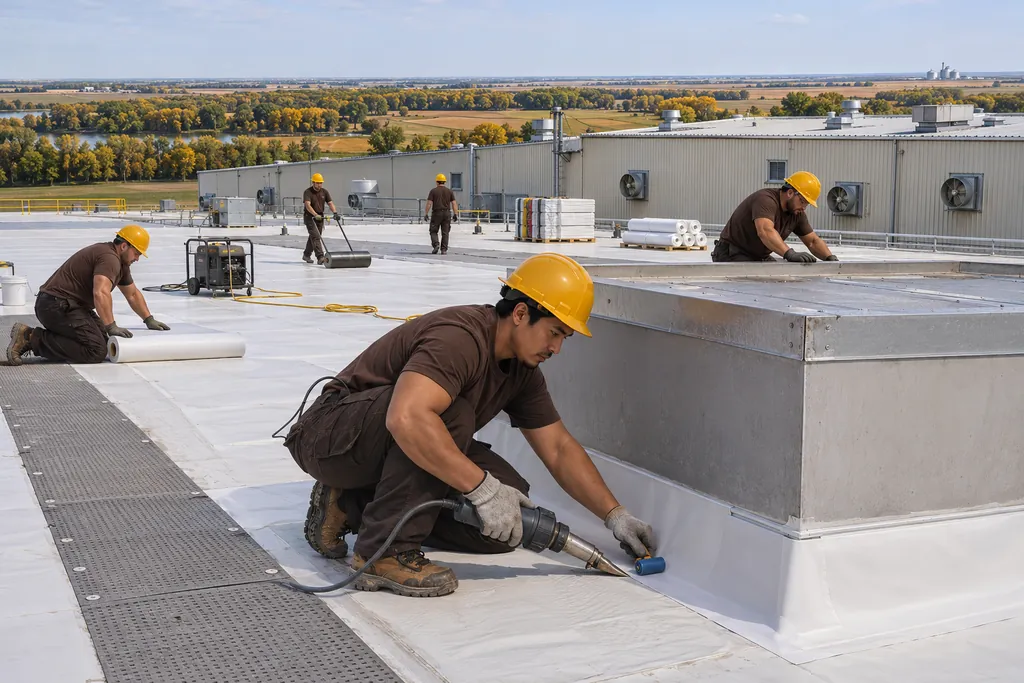
Flat roofing on Kearney commercial buildings is most often TPO or EPDM single-ply membrane over rigid insulation. TPO has heat-welded seams and a white reflective surface. EPDM is a rubber membrane with taped or adhered seams that stays flexible in cold weather. We match the system to the deck, drainage, rooftop equipment, and building use.
How long does a commercial roof last in Kearney?
Depends on the system
Commercial roof life in Kearney depends on the system, installation quality, drainage, and upkeep. Manufacturers commonly rate single-ply membranes for about 20 to 30 years, and metal roofs often longer. Hail, ponding water, sun exposure, and foot traffic around equipment shorten that. Drainage and flashing upkeep matter as much as the membrane choice.
What should Kearney property owners compare when choosing commercial roofing companies?
Written scopes
Kearney property owners comparing commercial roofing companies should compare written scopes line by line. Check the membrane brand and thickness, insulation R-value, tear-off plan, flashing details, and drainage changes. Ask how rooftop units and deliveries are handled during work. Proposals that name the same system make comparisons fair, while vague bids hide differences.
How does Kearney's weather shape commercial roofing choices?
Hail, wind, freeze-thaw
Kearney's weather puts commercial roofs through hail, strong wind, snow, and freeze-thaw cycles, and those conditions shape the system choice. Cover boards and thicker membranes improve hail resistance. Fully adhered or well-fastened systems resist wind uplift at corners and edges. Good drainage keeps snowmelt from refreezing at drains and scuppers.
Cost and Replacement Decisions in Kearney
When should a Kearney commercial roof be replaced instead of repaired?
Widespread wet insulation
A Kearney commercial roof should be replaced when leaks keep returning across many areas or insulation is widely saturated. A brittle, shrinking membrane is another sign. Isolated leaks at flashings and seams are repair work. Core samples and moisture surveys show how much of the roof is wet. Replacement makes sense when repairs would cover most of the roof.
What sets commercial roofing cost per square foot on a Kearney building?
System and tear-off
Commercial roofing cost per square foot on a Kearney building is set by the membrane or metal system, insulation thickness, and tear-off needs. Removing wet insulation or several old layers adds labor and disposal. Roof height, crane access, penetrations, curbs, and parapet flashing all change the count. We price after measuring the roof and taking core samples.
What happens to a Kearney retail strip during commercial roof replacement?
Stays open, phased
A Kearney retail strip can stay open during commercial roof replacement when the work is phased by tenant bay. We tear off only what can be dried in before the crew leaves each day.
Debris chutes and dumpsters are placed away from storefront entrances and parking. Tenants get notice before noisy tear-off over their space, and interior protection goes up where needed.
What drives commercial roofing cost for Holdrege businesses?
Size, system, layers
Commercial roofing cost for Holdrege businesses is driven by roof size, system type, tear-off layers, and wet insulation found during coring. Metal versus membrane, insulation thickness, and parapet or edge metal details change the total. Access for cranes and lifts matters on buildings with limited space around them. We price each Holdrege roof after measuring it.
TPO Roofing in Kearney
Can a TPO roof last 30 years on a Kearney building?
With thicker sheet
A TPO roof on a Kearney building can approach 30 years in some cases, but membrane thickness, seam quality, and maintenance decide it. Thicker membranes such as 60 or 80 mil commonly carry longer manufacturer ratings than 45 mil. Hail punctures, ponding, and traffic near rooftop units wear TPO faster. Regular seam checks and prompt patching extend service.
What are the downsides of TPO roofing in Kearney's climate?
Cold and hail
TPO roofing in Kearney's climate has a few downsides to plan for. The membrane stiffens in deep cold and becomes easier to puncture. Large hail can fracture it over hard insulation boards. Formulations vary by manufacturer, so quality differs between brands. A cover board, thicker membrane, and walkway pads near equipment reduce these risks.
How does TPO compare with EPDM for a Kearney warehouse?
Both can work
TPO and EPDM both suit a Kearney warehouse, and the choice turns on seams, reflectivity, and repair needs. TPO seams are heat-welded, and the white surface reflects summer heat. EPDM is black, stays flexible in cold weather, and uses taped seams. Warehouses with heavy rooftop traffic or many penetrations may favor one detail set over the other.
How are TPO seams welded on Kearney commercial roofs?
Hot-air welded, probed
TPO seams on Kearney commercial roofs are joined with a hot-air welder that melts the overlapping sheets into one piece. We set welder temperature and speed for the day's air temperature and wind. Each seam is probed with a seam tool after cooling. Cold mornings and wind affect weld quality, so test welds are made before production work.
EPDM Roofing in Kearney
What is the average lifespan of an EPDM roof in Kearney?
Rated 20 to 30 years
An EPDM roof in Kearney commonly carries manufacturer ratings of about 20 to 30 years, depending on thickness and upkeep. Seam tape, flashing at curbs and drains, and protection from foot traffic decide how long it lasts. Shrinkage at edges and seam lifting show up first. Regular inspections and timely seam repairs keep EPDM watertight longer.
What are common problems with EPDM roofs on Kearney buildings?
Seams and shrinkage
The most common EPDM problems on Kearney buildings are seam separation, shrinkage pulling at edges, and punctures from hail or dropped tools. Older lap-cemented seams fail sooner than taped seams. Flashing around pipes and curbs can split. EPDM also absorbs heat as a black membrane. Most of these issues are repairable with primer, tape, and patches.
Should a Kearney building use fully adhered or ballasted EPDM?
Adhered on most
A Kearney building should use fully adhered EPDM when the deck cannot carry extra weight or wind exposure is high. Ballasted EPDM holds the membrane down with stone and needs a structure rated for that load. Adhered systems resist wind uplift across the field and make leak tracing easier. Ballast stone can scour at corners in high wind.
When does an EPDM roof in Kearney need replacement instead of repair?
Saturated insulation
An EPDM roof in Kearney needs replacement when seams fail across many areas, the membrane is brittle, or insulation underneath is saturated. A few leaks at flashings are repair work. We take core cuts to check insulation moisture. If wet insulation covers a large share of the roof, a new EPDM system is usually more practical than patching.
Industrial Roofing in Kearney
What roofing materials work on Kearney industrial buildings?
TPO, EPDM, metal
Industrial buildings in Kearney most often use TPO, EPDM, or standing-seam metal roofing. The choice depends on deck type, chemical or grease exhaust, rooftop equipment, and building temperature. Plants venting oils or chemicals need a membrane rated for that exposure. Heavy-traffic areas get walkway pads. We match materials to how each plant operates.
How is roofing handled around rooftop equipment on Kearney plants?
Curbs and crickets
Roofing around rooftop equipment on Kearney plants needs raised curbs, proper flashing heights, and crickets so water flows around units. We coordinate with mechanical contractors when units must be lifted or disconnected. Walkway pads protect the membrane on service paths. Pipe supports sit on pads instead of resting directly on the membrane.
What does industrial roof replacement involve for a Kearney plant that must stay running?
Section by section
Industrial roof replacement for a Kearney plant that must stay running is done in sections. We remove only what can be dried in before the end of each workday. Dust control, ventilation intakes, and crane lifts are scheduled with plant managers. Interior protection goes below sensitive areas. Phasing keeps production lines covered throughout the project.
What should Kearney manufacturers ask industrial roofing contractors before work starts?
Phasing and safety
Kearney manufacturers should ask industrial roofing contractors how they will phase the roof, protect air intakes, and handle hot work. Ask about crane schedules, material staging, and fire watch during heat welding. Clarify who disconnects rooftop units. A written safety and access plan prevents surprises during production hours.
How do Kearney feed mills protect roofs from grain dust and exhaust?
Clean and seal
Kearney feed mills protect their roofs by keeping grain dust cleaned off and sealing every penetration around conveyors and vents. Dust holds moisture and clogs drains and gutters. Oils from some processes can soften certain membranes. We select membranes rated for the exposure and add walkway pads on service routes.
Commercial Metal Roofing in Kearney
What are the biggest problems with metal roofs on Kearney commercial buildings?
Fasteners and laps
The biggest problems with metal roofs on Kearney commercial buildings are loose fasteners, failed sealant at laps, and rust at cut edges. Thermal movement between hot and cold days works screws loose over time. Hail can dent panels and crack sealant. Poor flashing at walls and curbs causes leaks. Routine inspection and fastener maintenance address most of these.
Is standing seam or exposed fastener metal roofing better for a Kearney building?
Depends on use
Standing-seam metal roofs on Kearney buildings hide fasteners under raised seams and use clips that allow thermal movement. Exposed-fastener panels screw directly through the panel and need periodic fastener checks. Standing seam costs more to install but has fewer penetrations. Exposed-fastener panels suit ag and utility buildings where budget and simplicity matter.
What metal roofing works for agricultural buildings around Kearney?
Exposed-fastener steel
Agricultural buildings around Kearney commonly use exposed-fastener steel panels with painted finishes. Livestock and grain buildings need ventilation and condensation control under the panels. We specify panel gauge, fastener type, and closures for each building. Ridge vents, insulation, and vapor control prevent dripping inside. Standing seam is an option where fewer fasteners are wanted.
Can a new metal roof go over an existing roof on a Kearney building?
Often, with framing
A new metal roof can often go over an existing roof on a Kearney building using a retrofit framing system. The existing roof and structure must be sound enough to carry the added load.
We check the deck, framing, and existing layers first, and confirm recover rules with the City's building office. Retrofit framing can also add slope to an old flat roof.
How often should a Kearney commercial metal roof be inspected?
Twice a year
A Kearney commercial metal roof should be inspected at least twice a year and after major hail or wind storms. Inspections check fasteners, sealant at laps, ridge caps, gutters, and flashing at walls and curbs. Loose screws get replaced with oversized fasteners. Clearing debris from gutters and valleys prevents standing water and rust.
Kearney Permits and Building Codes
How are building permits for commercial roof replacement handled in Kearney?
Through Citizenserve
Building permits in Kearney are handled through the City's Citizenserve online portal, run by Development Services. The City's permit list covers all new construction, including additions, and certain repairs. For a roof replacement, ask Development Services if the scope needs a permit before work begins. We include that check in project planning.
Which building code edition applies to reroofing an existing Kearney building?
2018 IBC and IEBC
Nebraska's state building code adopts the 2018 International Building Code and the 2018 International Existing Building Code by reference. Neb. Rev. Stat. 71-6403 sets that adoption, and the existing building code covers work on buildings already standing. Kearney may enforce a local code that conforms generally. The City's building office confirms which edition applies to a reroof.
Commercial Roofing Near Kearney
What commercial roofing options suit Gibbon shops and processing buildings?
Metal or membrane
Gibbon shops and processing buildings commonly suit metal roofing or a TPO membrane, depending on roof slope. Low-slope roofs fit TPO or EPDM over insulation. Sloped steel buildings fit new exposed-fastener or standing-seam panels. Processing buildings with vents or exhaust need flashing designed for that discharge. We assess each Gibbon building's slope and use first.
How should Minden businesses plan commercial roofing for large hail?
Build for hail
Commercial roofing for Minden businesses should account for large hail. The National Weather Service in Hastings recorded 4.5-inch hail in Minden on June 12, 2002. A greenhouse east of Minden had major glass damage in that storm. We specify cover boards, thicker membranes, or heavier-gauge metal on Minden roofs where hail resistance matters.
What roofing details matter on Ravenna commercial buildings with parapet walls?
Copings and flashing
Ravenna commercial buildings with brick parapets and shared walls need attention at wall flashings and copings. Water entering through parapet caps can look like a roof leak. During reroofing, we check parapet height, counterflashing, and drain locations. Shared walls require coordination with the neighboring owner before flashing work on a Ravenna building.
How should Shelton business owners time a commercial roofing project?
Around busy weeks
Shelton business owners should time a commercial roofing project around their busiest weeks and the weather. Spring and fall bring workable temperatures for membranes and sealants. Businesses tied to harvest may prefer work before or after peak traffic. We set start dates, staging areas, and truck routes with the Shelton owner so deliveries keep moving.
Questions Left After the Kearney Commercial Roofing FAQ?
Send the address and what you see on the roof. We answer on site, after a roof walk.